Friday, July 25, 2014

If You Are A Culinary Fan Or Your Name Is Kristina Stewart, Nicole Thomas Or Allison Stiles, Read This.

I developed a fondness for cooking only recently. My cooking reputation was not a good one. I once burned water. Who knew that was even possible? Well I can tell you it is. And my poor son can also attest to my lack of mad cooking skills. But now I am on the upswing. Maybe I will beat Bobby Flay. Probs not.

Our group was invited to dine in the country and it was actually out in the country. Eat a few of these and sweat pours out of your face. Our friend from Texas on this trip, Thomas, has done it. And his face was sweating. True story.

The colors and smells of a Chinese kitchen are awesome. It is a mix of steam, garlic, cilantro (colander here), and hot spices of all kinds. 

Bright reds, whitest white rice, and the greenest of green are everywhere the eye looks.

Sticky rice pancakes drying out almost ready to bake. Sometimes they are breaded and fried. I have also seen them pressed between green tea wafers and fried. Sesame seeds cover the edges before they are served. 

Tea isn't an event. It is a way of life. The end.

Some sort of fruit was drying here. They tasted like huge California golden raisins. 

Big chopsticks are used for cooking. They are usually pretty long. About 1 & 1/2 feet or so in length. 

Rice, rice and rice. That is what breakfast, lunch and dinners have. Only it is served well into a meal. Not throughout. 

There are small woks in family kitchens. And industrial sized ones for school cafeterias. 


Spices for cooking include tons of sea sesame oil, garlic, garlic, garlic, colander, green onion , hot green and red peppers of every kind, sugar and soy. 


Yes children, there are others that suffer the task worldwide of doing the dishes. 

This lady is making soy milk. She puts a few ladles of soaked beans in the top of this contraption.

Then she uses muscles and physics and milk pours into bucket. It is strained and served hot. All drinks are warm or hot. Nothing like steaming hot beverages on a 110 degree day. 

Our bus driver helped out beating rice into a sticky oblivian.

This rice will be taken and partitioned into pancakes, or breaded and fried then rolled in sugar for dessert. Not a huge fan of this. Sort of like a cross between a fried donut, gummy candy and a hash brown. 

We took in a game of the Mahjong. Very different from virtual versions available online. The whole crowd around us had advice. We had no idea what the heck we were doing until the end. 

Dinner is served.


The people of this neighborhood gave us the warmest welcome and were generous beyond words. Our groups picture now hangs in the mahjong Game Center 'a wall. So fun. 

I Do Not Want To Go To Buddhist Hell And From The Looks Of It I Might But Probably Not.

 Up to the mountains we went. I have heard many times on this trip that we would be going into the countryside, to see more rural areas. Then we would end up in a place with populations exceeding 960,000 people. The perspective on small to me, a woman from Maine USA, differs drastically from that of my Chinese peers in the greater Chongqing area.


Our bus driver on the left is a stellar Mahjong teacher even though he doesn't speak a lick of English. Our local Chongqing guide, Fu (center) laughs like Mike Meyers and will do anything to ensure our experience is nothing short of fabulous. The man on the right is Zhai, our in-country escort, guide, historian, translator, dictionary, card playing teacher, and friend for life. This man will get us anything we need, steer us anywhere we want to go and will answer or find the answer to any one of our one million questions. The three of them ensured we would see something fantastic today. 


We were headed to see the Dazu Rock Carvings, a magnificent set of Buddhist sculptures carved in stone cliffs in Dazu, Szechuan Province, China. They, like the Terracotta Army, are designated a World Heritage Site.

 Upon entry to any Buddhist location, one can find bells. Buddhist temples are not temples without bells according to local tradition . 

I gave it a whirl. I am sure they heard me in the next town over. I may have gotten a little excited.  #maybeabsolutely

We hopped onto our sweet ride down a  very narrow winding path in a huge golf cart for 10. The driver was pretty good but scary Larry. If I drove Jimmy's golf cart like that Jenny and I would not beable to steal it so easily. 


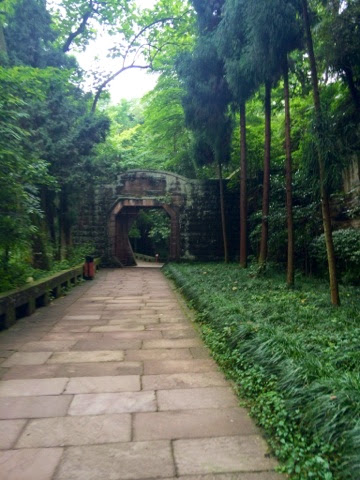
We are dropped at a path that leads us into a dense jungle thick with plush green vegetation. The land abounds with sounds of jerk cicadas. The air as usual, very humid causing constant perspiration. I used to be leary and afraid of the underarm sweat ring. China has broken me. I don't give a crap anymore people. It is good for the skin. 


We are at one of 5 sites that encompass what are collectively known as the Dazu Rock Carvings. The Buddhist grottoes at Baodingshan were carved during the Song Dynasty about 1200 (let's make this date simple). A few images were also added on during the Qing Dynasty and later. The site is about 500m long  with about 1 kilometer total length of sculptures. Sculptures and reliefs are between 3 and. 15 meters in height. 

The reliefs and sculptures highlight the faction of a monk named Liu Benzun. He was a pious layman of Sichuan Province who became venerated for his spiritual perfection. Three traditions, or branches, are represented: Zen, Huayun and Pure Land, blended with ideas from the Chinese social philosophies of Confucianism. The reliefs in simple terms are illustrated sermons in stone. They are lively, realistic and of high artistic quality.  They were used as teaching tools for common people and elite persons to explain concepts and stories of Buddhism and Confucian principals. They depicted ordinary people and situations. 


There are different series of reliefs that show how to reach ultimate liberation from the cycle of rebirth. Sections of carvings include reflections on Buddha's life, teachings on Karma, encouraging good acts (especially towards parents), discouraging evil acts ( Hell reliefs ), promoting various kinds of worship,and contemplation. 

 Our guide for this site unfortunately took us backwards through the site. I did not understand what I was seeing until I did further research. When traveling abroad, you can get lost in translation. I make notes on whatever I can and piece it together later.  Upon further research it dawned on me that we probably should have started the tour here with The Protectors of The Law. Why this did not happen may have been made clear, but the cicadas deafened me because that is what they do. Again, they are inconsiderate jerks. The Protectors warn that the journey to enlightenment is a difficult one, but achievable.  

The Great Wheel of Rebirth is about karma. Buddhists believe humans are reincarnated over and over into higher or lower forms of life according to one's past deeds. What you do in this life affects another life.  That is karma. Hmmm. This made me nervous for some reason. I may be in trouble in the next life. Holy!!!! I might come back as a cicada!!!! Ohhhh, I am very upset right now. 

This is a colossal head of Buddha. I mistook he may be sleeping however this 31m long reclining statue illustrates the death of Buddha. #awkward  #thanksunknowledgeabletourguide #not 

He is quite peaceful. The head is attended by two statutes. The one on the left is Zhao Zhifeng, the monk who supervised construction here. The other is the pious monk introduced earlier, Liu Benzun. 

To fully understand Chinese culture, you must know something about Confucianism.  In a nutshell, Confucianism is an ethical system and philosophy and Confucius was a teacher back in a time when China was in complete chaos.  He put forth ideas about how to achieve harmony in society.   There is a focus on practical order of people, ideas and things in life and a strong emphasis on importance of family.   Other basic ideas:  all people are teachable, improvable and perfectible, striving for perfection in personal life and communal life, having humaneness for other individuals, doing good, acting properly in everyday life, and having the ability to see what is right and fair in the behaviors exhibited by others.

A significant number of these carvings were dedicated to supporting and explaining the Confucian idea of filal piety which is a centerpiece of Confucian philosophy.  It means having respect for those who are above you in society:  leaders, elderly and most importantly, your family and parents.

These reliefs depict the respect that Buddha had for his parents.  In the top left corner it shows Buddha's parents at his birth and at the bottom center, Buddha with them during life, and Buddha carrying his parents' funerary items.

There are a million carvings here and for the interest of this post, which is already waaaaay lengthy, I will show you one more set.

The Buddhist Hell relief.  I really had no idea how intricate the ideas surrounding hell were.  I can't help but feel a bit (a lot) naive about the religion after visiting China and after teaching about Buddhism for so long in the classroom.  This is one of one million reasons why international travel for teachers is so necessary.  The in-depth understanding of experiencing another culture doesn't compare to what you can read in a lifetime.  

The elaborate hell relief vividly illustrates deities and officials in charge.  They are the ones looking over my head in the pic above.  My heart was pounding a bit.  I could feel the stare into my soul.

The relief includes punishments handed out to sinners.  And they look quite painful.  Being boiled in a cauldron by a horse headed warden, beaten into vats of excrement, impaled alive, and ground to pieces under a heavy toothed hot iron scares the wits out of me.

 Well vegetarians, you are safe from this punishment for killing animals for meat.  Most Buddhists are strict vegetarians.
The relief above I found interesting.  It illustrated all of the ill effects that out of control alcohol over-indulgence brings.  Theft, domestic abuse, enablement, and neglect of children and parents were all illustrated in the top row.  Breaking of the knees is the punishment here.   I heard a few moans from my peers and questions arose immediately about if glasses of wine were ok or not.   All were assured it was.  My Mormon friend and I laughed.  Hard.

For sinners out there - there is hope.  Buddhist hell is not eternal, unlike other religious traditions.   It is more like the Christian concept of Purgatory.  You better be nice to your friends and family though.  If you do not repent before you die, then it is up to them to release you from hell through prayer for you after you die.  #benicetomom


Tuesday, July 22, 2014

The Famous Terracotta Army Is Cool. Bury Me With Oreos Please To EnjoyIn My Afterlife

China has had its fair share of chaos throughout history. Back in the day, about 250 BCE (also known as BC for people down with sweet baby Jesus), there were many warlords vying for power in China. One man rose to unify warring groups using language, economics and good old fashioned violence. 

His name was Qin Shi Huang, Zheng for short. He was not as big as the statue above, but his persona sure was. He unified China, gave it it's name, standardized weights, measurements and money (to stop all the arguing among citizens), built the first version of The Great Wall, and built a new national road system. Not everyone appreciated his efforts and he survived numerous assassination attempts but later it is said, died of mercury poisoning after drinking it believing it would bring him eternal life. I can't imagine how that tasted.

Before he died however, work was started on a masoleum, or funerary tomb for the emperor when he ascended to his throne at the age of 13. It was a project that was grand in size, involving over 700,000 workers and taking 37 years to complete. The result was to later become known as the famous Terracotta Army and today we traveled to see it. 

The song line,  "I've got a golden ticket," from the old school Charlie and The Chocolate Factory movie ran through my head when this admission ticket was handed to me. I think I even skipped a bit on the way in. 

In 1974 local farmers were minding their business and plowing their field. They needed a well so digging began. The shovel hit something and what they found caused the local authorities to contact archaeologists immediately. 

What they found were a collection of terracotta sculptures depicting the armies of Qin Shi Huang.  All of them. It is a form of funerary art meant to protect the emperor in his afterlife. 

There are three pits that contain an estimated 8,000 soldiers, 130 chariots with 520 horses, and 150 Calvary horses, the majority of which are still buried in pits nearby. Other non military figures were also found buried and include officials,  acrobats, strongmen and magicians. The emperor was evidentially planning on taking entertainment too because everyone knows just how boring the afterlife can be.


Pits exist with unearthed figures. There are two reasons given for this. The first is that the technology to unearth them and preserve the paint. Paint on figures already unearthed began to flake and fade. Lacquer was used to cover the paint, but can curl within as fast as 15 seconds once dry air hit it. Structural integrity and preservation are problematic. 

The second reason was that the Chinese feel that this also gives time to preserve the find for future generations. China's rapid rates of urbanization have people here concerned with cultural preservation. Rightfully so. 

Heads, arms, legs and torsos were created seperately and then put together. Each face was designed resembling each individual in the army. No two are the same.
After each was made it was placed in precise military formation according to rank and duty. 

Most held real weapons like spears, swords or crossbows. It is believed that many weapons were looted or rotted away.

Stone armor helmets and suits were on display.


Walking through the museum I came around a corner and saw a ton of people crowded around a display pushing into eachother and snapping photos. The amount of flashes in the room made me think that paparazzi were on the loose. Suddenly I felt a hard shove from behind only to turn around and see an old woman about 80. Bring it on I thought, but quickly changed my mind. She was a woman on a mission. The elderly if this country are fit as fiddles. If it came to a throw down between us, she would have wiped the floor with me. I stood aside. Quick. 

What they were all crazy about seeing was the Qin Bronze Chariot. It is two pieces, the first a driver with two seats and an umbrella and the second, a separate carriage. Both have horses 50% the size of real ones. They were found shattered in the 1980s and were put back together. Took about 5 years of painstaking work. Combined they are one of 64 artifacts that can never leave Chinese soil. No traveling exhibitions for them.

Samples of the first unified writing system.

Tiles.

An oasis is tucked between Pits 1 & 2. Inside we found a miracle.

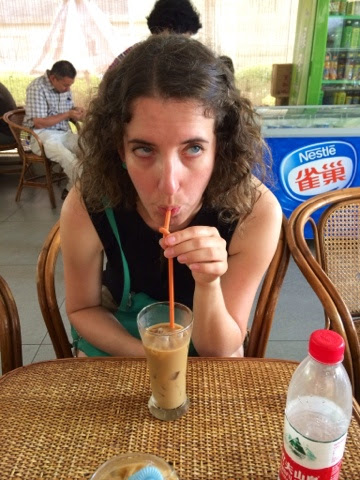
Iced coffee. The Chinese are drinkers of tea. It is sometimes very hard to find a coffee or a good coffee here. Often, iced coffee isn't really iced either. A lot of beverages are served warm as traditional Chinese medicine dictates that warm and hot water is better.  This carries over into other drinks.  But Clara and I did not follow that philosophy this fine day. #sorrynotsorry