Some people just get it. I wish everyone did. Sadly, this isn't the case. There was an instance that illustrated that this year when a high school teacher I know refused to allow their students go to a presentation being given by the United States Ambassador to Haiti, Pamela White at our school, the high school she happened to graduate from. Teachers are busy. They lose a lot of class time to an endless list of activities and assemblies, so the rationale being given that they were going over homework in class wasn't the problem. That was understandable. It was the last part of the rationale that was given that really sent me for a loop and reflected a disturbing mindset:
"They don't even know what an ambassador is anyway, so it doesn't matter."
That individual would have done well today to see one of the best speakers that exists on this planet, because it was her that gave an answer for why it does matter. I am hoping you will enjoy her story as much as I did.
The woman on the right's name is Wu Qing a well known Professor of English and social activist of women's rights and human rights in China. To push for democracy, freedom and rule of law, she was the first People's Deputy (position similar to a US state congressional rep) to use the Chinese Constitution to do so.
She taught English at Beijing Foreign Studies University from 1960-2000 and since 1980 has been promoting women's rights and human rights. She is co-founder of Beijing Changping Practical Skills Training Center for Rural Women. Since 1999 it has trained over 13,000 rural women and girls from poor areas in China.
She became People's Deputy to the Haidain District People's Congress in 1984 and served 7 terms at District level from 1984-2011. She was democratically put forward and elected by her peer deputies. She is regarded as the "Deputy with the Constitution" by the media in China.
So now that you have that background, I thought I would simply give you her story as she told it. The following are a collection of quotes from her presentation today. The best way to know someone is in their own words.
Good afternoon world citizens. I address you like this because the world is getting smaller.
Over 13,500 women and girls were trained at the school I founded for rural women. It is non-profit, non-governmental organization. Sense of integrity, rule of law, and honesty are taught. The name of the school is Beijing Changping Practical Skills Training Center for Rural Women.
After I graduated from Wellesly College, I traveled to rural China. What I saw changed me. They did not have enough to eat. They ate peas with the shells on because that is all they would have. I decided to change China and so I knew I had to start to change the rural areas.
To change rural areas you must change women. To change China, you have to change the countryside. To do that you have to change the status of women there.
Women give life to the world. They nurture life.
If you educate a woman, its like educating a whole family, even several generations of a family. .
We educate and train women to become teachers and typists. We started an adult start your business, to help women to create jobs for themselves and fellow women. We give women the opportunity to bring themselves up. We train women to do something for the community. They have to learn how to take care of drinking water, soil and air. They have to know how to prevent the government from building chemical factories and leather factories. Business owners don't care about local people. They are there to make a profit. Women have to know how to monitor them.
Prices for water and electricity have gone up. It is very difficult for rural people to survive. The younger people go into the townships and cities to make enough money to support the family. Elderly women and men are left behind and often children. Some younger people go back to give birth to children and do not have jobs. We teach women who are left or women who return how to take care of the elderly.
Our world lacks love. It is the cause of every conflict, local war and is the cause of poverty.
In China we lack love and trust. The whole world lacks it really. They are very basic universal values.
That is one part of my work. The other is a story about government.
Since 1949 there have been many political movements in China (about 58 different kinds).
Often targets were intellectuals who had critical thinking who thought differently than Mao and Party preaching. During that time if a person was labeled as reactionary, the rest of the family were encouraged to disown this person.
If you don't love your family anymore because they are cut from your life after you accuse them than who do you love? There was a lot of hatred. People turned inward. They have to take care of themselves. It has been going on and on since the Cultural Revolution.
My mother was Xie Bingxi. She was one of the most prolific Chinese writers of the 20th Century. She earned her Master's Degree in literature at Wellesly in 1926. She married my father, Wu Wenzao an anthropologist who is also known as the father of sociology in China.
In 1956, my parents were labeled as rightists, imperial lackeys, and reactionaries after my father publicly attacked the Party and after my mother refused to divorce him for doing so.
They were looked at fish leaping out of a net.
I suffered. I later was asked to say that an old party secretary of the school had supported attacks against the government coming from my school. I refused at first. But after 80 meetings with officials, I gave up telling the truth. I felt awful for lying. I told lies to save my own skin. I decided right there and then, never to tell a lie again.
I wanted China to be a country ruled by rule of law, not by rule of man.
I insisted on speaking the truth, something quite difficult in China. I didn't care, I didn't want to follow the mainstream.
I was the first person to study the Chinese Constitution and use it to argue my points. I learned it well dedicating much of it to memory so when arguing a point with someone, I could answer quickly.
I went to the US and became a visiting scholar at MIT. I returned to China in 1983 and ran for position of People's Deputy. I was elected.
I met with people everyday. I made time to hear them all because that is what people need and want, to be listened to.
When people came to me with a complaint, I would ask them which policies or which laws in the constitution were violated? What hard evidence did they have? I wanted to push for rule of law. You must have evidence. Evidence was not asked for by Communists. I was the first person to ever vote no against the Party. I was Deputy until 2011 when I did not get re-elected. I was labeled as someone who just always wanted to be difficult. There have been times I have not been allowed to leave the country because I am outspoken.
It is every single person's right to speak. Respect people as human beings. That is all everyone wants.
It is students today who are the ones speaking. Democracy is a process. It depends on citizens how it will go. You can choose to participate and do something. So do it.
We should train global citizens to be aware of what is going on around them. Extreme nationalism and ignorance kill. If you always look at things from one perspective it is dangerous. You must put forth all views.
We as teachers must train a whole person. Every person should know their rights and responsibilities, economic independence, environmental protection, heath& sanitation, education and peace against violence and wars.
Every person should be fed and every person has the right to speak, only then will we have harmony.
It is not enough to make bank, chase materialism, we are humans and should want something bigger for the world. Materials do not fill you up. They do not create love.
The more I travel, the more I feel there are more similarities than differences. We all face the same types of issues everyday.
Teachers should be global role models. It is most important.
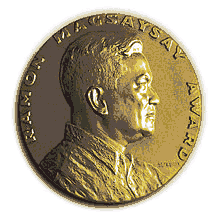
This is the Ramon Magsaysay Award. It is considered to be Asia's Nobel Peace Prize. This was given to Wu Qing for her humanitarian and political work.
There are people that pay attention in this world and do see that global awareness and participation do matter. We share a planet. We share religions, cultural practices, economies, and art. We share the fact that we are part of families who want the most basic of things to live and enjoy life. I assure you, it does matter that we as teachers, make knowledge of the globe priority. Such commentary as "it doesn't matter" is not only ludicrous, but downright reckless and dangerous. For the love of god, be part of the solution instead of part of the problem.